Nearly every fundraising platform shipped an AI feature this year. Most of those features run on donor records that have been accumulating errors, inherited assumptions, and quiet omissions for decades. That combination, not the technology itself, is where the risk sits.
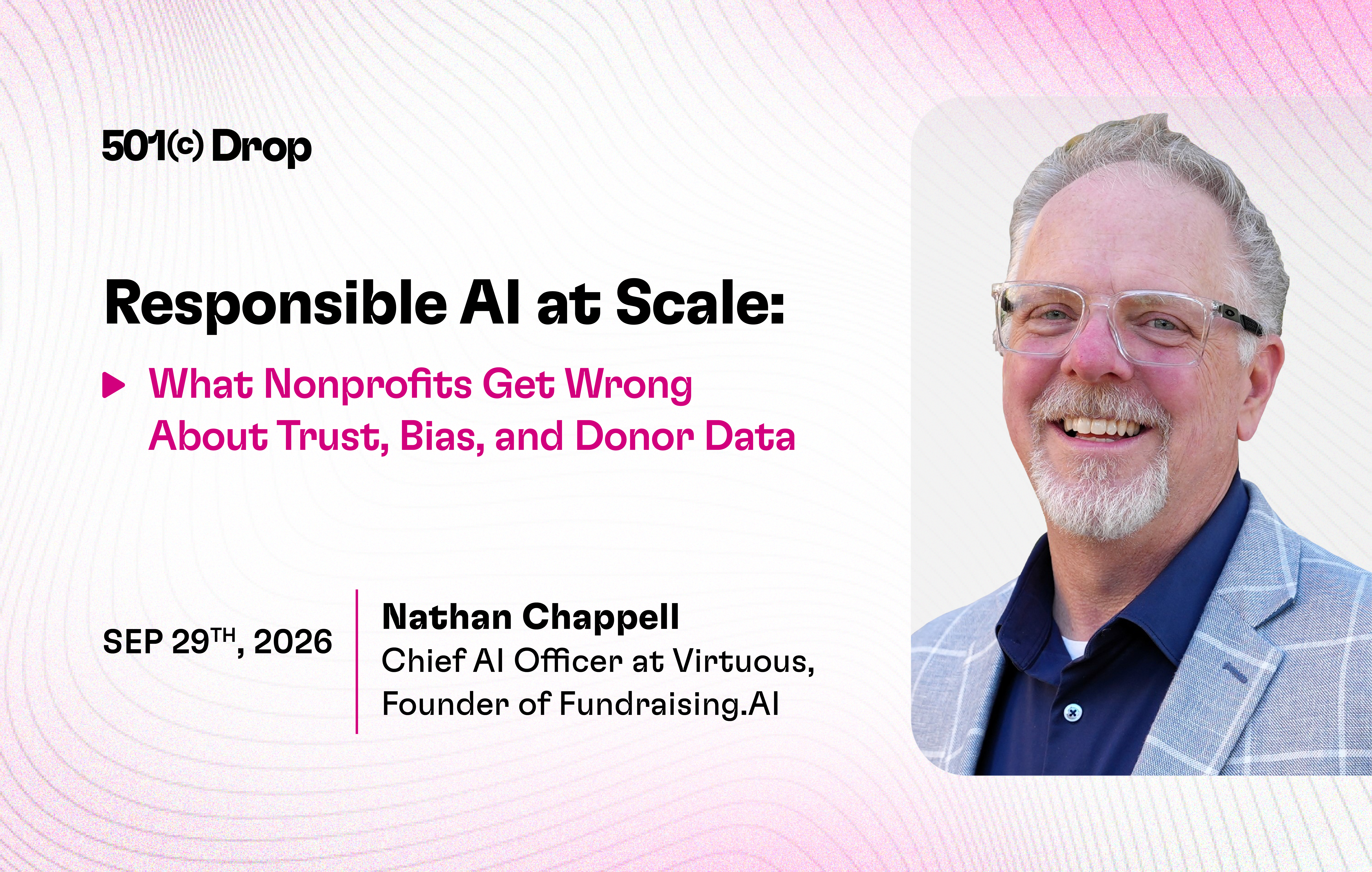
Nathan Chappell has spent two decades inside the nonprofit sector and now serves as Chief AI Officer at Virtuous. In 2019 he founded Fundraising.AI, whose open source responsible and beneficial AI framework is used by organizations and nonprofit tech companies in more than 140 countries. On the 501(c) Drop he made the case to BetterUnite CEO & Co-founder Leya Simmons that the sector's AI problem is a data problem first and an ethics problem second.
Most nonprofits find and rank donors using an RFM score: recency, frequency, monetary value. The method predates computers. Catalog retailers developed it in the 1950s to decide which households were worth the cost of a mailing, sorting customers into physical card buckets by how recently and how often they had bought.
Nonprofits adopted it wholesale, then layered wealth data on top of it. By Chappell's assessment that made a flawed method worse, because it added a second variable that does not do the job it is credited with.
This is what "bias lives in your CRM" means concretely. An organization that has screened on wealth for fifty years holds a database skewed toward older and whiter donors. A model trained on that history does not correct the pattern. It reproduces it faster and at larger scale than any staff member could.
The replacement framing is simpler than the one it displaces: wealth is not the signal, connection is, and a person's degree of connection to your organization changes over time.
Two experiences pushed Chappell from skepticism to building. The first was buying a predictive model that performed badly and discovering, on questioning the vendor, that patient status had been excluded from a model built for a cancer hospital because the vendor capped how many variables it would accept.
The second was building one in house. The baseline numbers for patient acquisition at a large hospital:
The operational shift mattered as much as the number. The old pattern was to buy or build a model, watch it degrade, blame the vendor, and start again. A continuously retrained model ends that cycle. It also raises the stakes, which is why bias mitigation, privacy, and security stopped being theoretical for Chappell at this point and Fundraising.AI followed.
Responsible AI now has a reasonably settled global definition. Stripped of marketing language, a system qualifies when it is:
In a fundraising team, that looks like removing gender, race, and wealth from the inputs and examining what remains, then assigning someone to review what the model surfaces before it reaches a donor. Chappell's caveat is that this is a floor rather than a standard. Responsible AI answers only what the model is doing today.
Chappell's team reviewed responsible AI frameworks worldwide while building Fundraising.AI and found them all written for the private sector, where the operative question is reputational and financial exposure. Two differences make that insufficient for nonprofits.
Social media is the cautionary case. Built to connect people, it would have passed a responsible AI review at launch. Anything that fails either test should not ship, or needs more information before it does.
The sector's slow adoption can be read as discernment. Chappell reads it against a harder fact: the sector is not healthy, and the pressures on it are compounding. Political upheaval, public scrutiny, donor apathy, and a general erosion of trust in institutions all point toward a smaller nonprofit sector facing the same relevance question higher education now faces.
Meanwhile donor expectations are being set elsewhere. The average person encounters three to four thousand algorithms a day. A coffee app has already weighed the weather, the previous order, and local ordering patterns before it displays anything. Chappell's estimate of how long the sector has before the gap becomes obvious to donors is not ten years. It is roughly nine hundred days.
He is equally clear about why regulation will not close that gap quickly. Comparable regulatory bodies took twenty to forty years to establish, and none of the technologies they govern improve themselves recursively.
The practical obligations are narrower than the existential framing suggests.
The result, in his experience, is not resistance. It is relief, because almost nobody defends mundane repeatable work once they are asked directly.
Chappell's near-term forecast is that fundraising becomes self-service and the internal silos dissolve, because a fundraiser who does not want to wait on prospect research, donor relations, or communications will simply do the work themselves.
The shape he describes is closer to a daily brief than a database.
Before letting any AI feature near donor records, there is a short list worth putting to a vendor:
None of those are technical questions, which was Chappell's closing point.
Any position on AI, optimistic or otherwise, reduces to how much confidence someone has in the people using it. That makes the vendor conversation a values conversation, and it makes the state of your donor data the first thing worth fixing.
Transcript Recording:
Leya Simmons (00:01)
Hi everyone, welcome to the 501c drop. I'm Leah Simmons and I am your host as well as the CEO and co-founder of Better Unite. I am joined today by Nathan Chappelle. He is our the sorry not our the chief AI officer over at Virtuous. Nathan has quite the career with nonprofits as well as nonprofit tech, as well as fundraising.ai.
he was really has been one of the pioneers and frankly, Nathan, I don't know if you know this, but you've really influenced the way that I have thought about AI and the way that we have implemented AI here at Better Unite. We were among I think some of the early joiners of fundraising.ai when we were a much smaller platform. So anyway, welcome. I'm so happy that you're here.
Nathan Chappell, Virtuous (00:49)
Awesome.
Yeah. Well, what a treat. I this is I feel like this conversation's like a long time coming because we kept on, you know, running into each other and connecting virtually
Leya Simmons (00:57)
Yeah.
Nathan Chappell, Virtuous (00:57)
and in person. So it's great. Thanks for having me.
Leya Simmons (01:00)
Absolutely. It's actually even funny. It was like kind of odd coming up with questions today because I've heard you speak so many times that I actually
Nathan Chappell, Virtuous (01:05)
Right.
Leya Simmons (01:06)
could like kind of in my head hear some of what you're say you might say. But I think I bl we the AI has been in the news a little bit. Regular folks are seeing
Nathan Chappell, Virtuous (01:15)
Ha ha ha.
Leya Simmons (01:16)
it in their news feed on the regular. So I'd I'd like to talk to you about some of that if that's okay with you today.
Nathan Chappell, Virtuous (01:20)
Sure. Yeah, always
something new for sure. That's yeah. It's perfect for ADHD person like me 'cause it's like I mean it literally every about twelve minutes something new comes out.
Leya Simmons (01:30)
That there's zero exaggeration in that statement, actually. Yeah. Okay, well let
Nathan Chappell, Virtuous (01:32)
Yeah. Yeah.
Leya Simmons (01:33)
me read a really quick bio of you, things that you might not really say about yourself, but I would also love for you to introduce yourself to us. So
Nathan Chappell, Virtuous (01:39)
Okay.
Leya Simmons (01:40)
Nathan Chappelle is the chief AI officer at Virtuous, where he leads the company's approach to building AI into nonprofit fundraising software responsibly. In twenty nineteen, is that date right or twenty eighteen?
Nathan Chappell, Virtuous (01:52)
twenty nineteen f for FAI, yeah.
Leya Simmons (01:53)
2019,
fundraising.ai. Okay. He founded fundraising.ai, a global initiative that created an open source, responsible, and beneficial AI framework now used by nonprofits in more than 140 countries, as well as nonprofit tech companies. He's the author of The Generosity Crisis, Nonprofit AI, which I realize I have a copy of, you can't see it, but it's literally right behind me. And you have a new book coming out, In of One. Is that right? Do I have the title right? In One Philanthropy, apologies.
Nathan Chappell, Virtuous (02:19)
Yeah, N one philanthropy, yeah. Yeah,
no.
Leya Simmons (02:23)
so that comes out next month. Nathan also sits on the Open AI Users Forum and the Forbes Technology Council and has spent his career at the intersection of nonprofit leadership and emerging technology, with two day decades in the sector before AI ever came into the conversation, came into the chat. Welcome, Nathan. Thanks again.
Nathan Chappell, Virtuous (02:43)
Well great. Yeah. Thanks, Leah. It's great to be here. And yeah, it was a great introduction. I yeah, I always call myself like an I was an accidental fundraiser for almost twenty years and kind of bookended I was technologist before and and now and so yeah, but it's a great intersection of all those things coming together.
Leya Simmons (02:59)
W so you were a technologist before you entered into the nonprofit world? I didn't know that.
Nathan Chappell, Virtuous (03:02)
Yeah. So I I
s yeah, I started a company in undergrad that was a data storage company. In fact,
Leya Simmons (03:08)
Okay.
Nathan Chappell, Virtuous (03:09)
I so I learned a program then and learned how to build databases and then got bored. I sold that company and started started dot com in ninety seven. the first company to sell skis on the internet because I I like skiing and so why not?
Leya Simmons (03:22)
cool. I like skiing too.
Nathan Chappell, Virtuous (03:24)
And then and I learned never turn your hobby into your job and then sol
Leya Simmons (03:27)
learned that lesson myself.
Nathan Chappell, Virtuous (03:28)
Yeah,
yeah. Sold that, went to grad school and then fell in love with nonprofit work kind of on accident. I was I didn't I was taking a year or two off to just go to school and I served as a board member at a local boys and girls hub and our director resigned to move to another state and I was like, I'll keep an eye on things for a little while and lo and behold, yeah. Yeah, exactly. That
Leya Simmons (03:49)
Cut two twenty years later.
Nathan Chappell, Virtuous (03:51)
ba exactly that. And then working in AI starting around twenty seventeen, yeah, twenty eighteen.
Leya Simmons (03:56)
So, okay, my background is working with nonprofits as well. And that honestly in nonprofit tech makes us a little bit unusual. Like most folks
Nathan Chappell, Virtuous (04:03)
Yeah.
Leya Simmons (04:04)
come from only tech world where you've got this vast experience. So that's actually leads me right into my first question, which is how does having a background working with and within nonprofits change what you notice, noticed pre-2019 and notice today, as opposed to like maybe somebody that only has that tech.
point of view.
Nathan Chappell, Virtuous (04:27)
Yeah, that's a great question. I yeah, I don't get that question often. I and I think it's actually fairly significant in that, you know, I my orientation, even though I'm in the private sector, you know, Virtuous is a for profit company, my orientation is in like always is as a fundraiser. Like as a nonprofit professional, you like can't take it out of me. And I'm like highly protective of
Leya Simmons (04:45)
It's hard to shed. Yeah. Mm-hmm.
Nathan Chappell, Virtuous (04:50)
you know, the the sector and the work and understanding the nuances. So
You know, starting out in like really small nonprofits helped a lot because I know the struggle of like, you know, I was a grant writer, I was a games room operator, I like I mean all the things. Like I'd pay the bills and and then moving your way up and and then getting to where and I, you know, the roles that I ended with had a few hundred employees. there's almost not a job that I haven't done. And so I remember reflecting on this. So when I
My last role at City of Hope, I senior vice president at City of Hope. I mean, I learned like I think vendors hated me. I was brutal to them. Like and I
Leya Simmons (05:29)
Bet you were.
Nathan Chappell, Virtuous (05:30)
was brutal. Like I I was like, you don't know me. Like you come in and and you talk about like our customers and I'm like, no, excuse me, they're donors. Get out of here. And like,
Leya Simmons (05:37)
Yeah. Mm-hmm.
Nathan Chappell, Virtuous (05:39)
right. And so brutal to them. And so I think that does to your answer a question, I think that does provide a lot of I don't know.
direction for in how I I think about the work. And then, you know, fundraising AI was a direct reflection of that because it was the idea that, you know, if you're whoever, ATT or Nike, and you're trading money for products or services, the stakes are very low. You don't have a lot to lose. If you're creating r AI policies and it's like, you know, we manipulated a person to buy a pair of tennis shoes. It's a very different
paradigm than a nonprofit that uses AI to manipulate a donor to make a gift. And so
Leya Simmons (06:23)
Hundred percent.
Nathan Chappell, Virtuous (06:23)
fundraising AI, you know, came out not as an advocacy organization for AI, but as an advocacy organization for responsible and beneficial AI. I think that would have not happened that there's no way that would have happened if I had only come to the like technology channel, because
Leya Simmons (06:39)
Right.
Nathan Chappell, Virtuous (06:40)
I wouldn't have even really understood the nuances and like how trust is so hard won and easily lost.
and why the nonprofit sector by definition requires a different set of like requirements, if you will, or guidelines in terms of like what you should or shouldn't do.
Leya Simmons (06:59)
Yeah. Our our quote unquote clients, our donors, move at the speed of trust and that's it, and that breaks and then you're lost. So it's it is really interesting.
Nathan Chappell, Virtuous (07:04)
Right, exactly. Right. Yeah, exactly. So I think it that
orientation I think is it d directly funnels like the work, you know, that I do for sure.
Leya Simmons (07:15)
So what was it in 2017, 16, 18, up to 19 that that let you
Nathan Chappell, Virtuous (07:21)
Yeah.
Leya Simmons (07:22)
see the crystal ball into the future that was AI and how it would impact fundraising?
Nathan Chappell, Virtuous (07:26)
I mean so I'd always been I mean by like prime primary orientation, like an early adopter.
Leya Simmons (07:34)
Mm-hmm.
Nathan Chappell, Virtuous (07:35)
like I mean that's why I started dot com in ninety seven, which is not like it's not it
Leya Simmons (07:37)
Yeah, I noticed that date.
Nathan Chappell, Virtuous (07:39)
like I mean, that's the time where I mean you had to learn HTML and you know, website costs you two hundred thousand dollars and you know, it's not super easy. but I I absolutely could see the future of like where this is going. I'm like, I wanna be part of it. So in twenty twenty seventeen,
Really, it was this idea that like we like I spent at that point 17 years raising money and my job never got easier. Like
Leya Simmons (08:04)
Yeah.
Nathan Chappell, Virtuous (08:04)
I had to reflect on this the reality of like how do you how do you spend like sixty or seventy hours a week doing something and it never got easier?
Leya Simmons (08:11)
Doesn't change, yeah.
Nathan Chappell, Virtuous (08:12)
Right. And so the the part of it is like, okay, this the role is getting harder, but we keep on like, you know, pounding a a square peg into a round hole. It's like it was just like hitting your head against the wall. And so
You know, as kind of an early adopter, I had started looking at the private sector and and what like others were doing. I remember reading an article probably around that same time in Harvard, titled Those That Fail to Use AI may never catch up. And I was like, huh, like that's interesting. And and it really explained how AI had like a combo compounding effect
Leya Simmons (08:44)
Mm-hmm.
Nathan Chappell, Virtuous (08:45)
that it wasn't like and it wasn't measured in years. It was measured in like cycles and how often the AI was retrained. And I was like, this is different.
And then a a series of events happened for me just real quickly where I bought a predictive model from an organization and it was horrible. And I thought, well, and I started questioning things like, well, what data did you use? And and this was at a cancer option. I'm like, well, what what what's the relevancy of like someone being a patient to making a gift versus not a patient? And they responded, Well, well, we actually didn't use that variable because we only have certain number of variables that we can use in these models.
Leya Simmons (09:20)
To train. Mm-hmm.
Nathan Chappell, Virtuous (09:21)
And I remember after my head stopped spinning in circles, like I was like, this is not okay. Like, and I just became super annoying and decided to ask every person I could possibly find that knew how to spell AI what they were doing, what they weren't doing, what was working, what was not working. I hired a PhD a data scientist on my team. I yeah, and I just decided lit like consciously to become like the most annoying person on the planet. And
And even though I'm not like I don't have a math background and and AI was very math driven at the time, I just so I had to ask the same question like a hundred times until I fully understood it. Yeah.
Leya Simmons (09:58)
Really explain this to me, yeah.
Nathan Chappell, Virtuous (10:00)
And then what when I knew it would actually change, so we spent a year building our first model. in patient acquisition. So like, you know, average hospital has about two million patients a a year, but
Leya Simmons (10:10)
Mm-hmm.
Nathan Chappell, Virtuous (10:10)
only two percent of patients ever make a gift. And our response rate of like trying to acquire a new patient donor was point six percent.
That's pretty standard average, like point five to whatever. And we are point six percent to the point where it's like, is this even worth it? It's really expensive. Like, you know, it's
Leya Simmons (10:24)
We're not changing it.
Nathan Chappell, Virtuous (10:25)
like, right. And these, you know, are they good donors or not? And we built our first model, took us a year, built that first model, and we hit 2.5%. And it was so five X in one, like, yeah.
Leya Simmons (10:35)
Yeah.
Nathan Chappell, Virtuous (10:37)
And that was like, I'm like, okay, this is gonna change everything. And then that that really, because it was gonna change everything, I felt compelled.
Because things like around bias mitigation, like perpetuating bias in our data, privacy, security, all those things were like really now no longer philosophical. That's when fundraising the idea of fundraising AI came. Cause I'm like, okay, let's find other people in the industry struggling with these same questions and let's get together and see what we can do to like really help shape what we now call responsible beneficial AI from from that early time.
Leya Simmons (11:12)
So so okay, I think I feel like you really just gave an example, but do you have other examples of like when you're saying that the bias lives inside a CRM or a wealth screening tool, like what these are things that our nonprofits are using already every day, whether they, you
Nathan Chappell, Virtuous (11:26)
Yeah. Yeah.
Leya Simmons (11:27)
know, some powered by AI, some not, some don't people don't really know if they are. What what are some like what are some examples, really examples that that looks of what that looks like?
Nathan Chappell, Virtuous (11:37)
I mean, most of them won't sound very good. I mean, here's the reality is that the nonprofit sector has been using RFM scores as a primary way of like prioritizing finding and prioritizing donors, right?
Leya Simmons (11:49)
Mm-hmm.
Nathan Chappell, Virtuous (11:50)
The RFM score was developed by catalog manufacturers in like the fifties. Like it literally it's so catalogs are very expensive. And you know, that you know, do you I don't know, you're younger than I am. So like I remember a day when there was like these catalogs, like you could see like amaz maybe it was like okay.
Leya Simmons (12:06)
The J Crew catalog?
Like I dog eared that and called and ordered things. Yeah. Yeah. Right.
Nathan Chappell, Virtuous (12:07)
Okay. Yeah. And and they're expensive. They don't just send them to everybody on the block, right?
They so they use RFM score to decide who, you know, recency, frequency, monetary. And originally, because there are no computers, they actually had like flashcards and they would organize them. It's like this bucket and this bucket, this bucket, and you then you figure out who you're gonna send them to. So our s our sector had like by default adopted a technology that was never intended for it in whole.
And then for my entire career, used that to like to do this. And so the worst part is actually then wealth data came on the scene. And and everyone was like, well, let's, you know, let's build that RFM score based on how wealthy people are. And so the very first data science project we did, so this was a bit in 2018, we got back and found that when when you look at the two percent of patients that were going to make a gift,
Leya Simmons (13:01)
Mm-hmm.
Nathan Chappell, Virtuous (13:03)
Machine learning is really good at taking lots of data and then telling you like what's the most predictive part of the data. So out of a thousand data points, not all thousand data points are ranked equally. They're literally ranked from highest, most predictive, to lowest predictive. And the highest predictive are like, this is where we want to put our our effort. I started looking at wealth, finding out that wealth, wealth is not showing up at all. Like wealth is less than 10% indicative of whether someone was was generous.
Leya Simmons (13:31)
Interesting,
huh?
Nathan Chappell, Virtuous (13:32)
Yet
I scanned our sector and found that over 80% of nonprofits are using wealth data as a primary way of finding someone. So they took this like broken RFM thing, and then they they even made it worse because they put gasoline on it by by adding wealth data on top of it. And
Leya Simmons (13:48)
Yeah.
Nathan Chappell, Virtuous (13:48)
then and then and and still to this day in 2026, I would say that's still how probably a vast majority of nonprofits are are prioritizing. So, you know, I think AI, the best example is AI.
outside of like when we talk about generative and the gentic AI and where this goes, but for like now, even the last five years to eight years, it lets us reimagine like or solve for things that we could have never solved for before. It's not that, you know, wealthy people are more generous. It's that everyone is unique and has a degree of connection to you. And then also that degree of connection changes. So yeah. So I I think the
Leya Simmons (14:24)
Right. Over the course of a downplay.
Nathan Chappell, Virtuous (14:26)
other big epiphany at the time was because I had my entire career
either built models or bought models from people and realized that with AI that you would never do that again. Like I remember this first
Leya Simmons (14:39)
Yeah.
Nathan Chappell, Virtuous (14:40)
model. It took me a while. I was a little slow on the uptake on this, but it took me about a year to realize like it was like, when are we going to build another model? It's like we never will build another model. We'll just literally in continue
Leya Simmons (14:48)
But does it's no longer necessary, yeah.
Nathan Chappell, Virtuous (14:50)
to improve this model. That was a f like at the time that was a really
Leya Simmons (14:53)
Pretty exciting.
Nathan Chappell, Virtuous (14:54)
yeah, that was a big paradigm shift for sure. That was like 'cause I
can been conditioned always. Like build another model. Some people are happy about it. High fives. Six months later there's knife fights in the hallway and how bad the model is and fire the vendor and like the
Leya Simmons (15:06)
Right.
Nathan Chappell, Virtuous (15:08)
whole cycle repeats over and over again.
Leya Simmons (15:11)
Interesting. So okay, you've used this term a couple of times. And that's a really fascinating background, actually, by the way. I had no idea about the RFM model coming from catalogs. Makes perfect sense,
Nathan Chappell, Virtuous (15:19)
Yeah.
Leya Simmons (15:19)
but I didn't realize that. you've used the term responsible AI a couple of times. And I wouldn't I wanted so I I would love for our conversation to kind of like bring down out of the clouds, out of this like
AI, I don't know, word salad cloud that it lives in and that it could mean a million I always said that
Nathan Chappell, Virtuous (15:36)
Yeah.
Leya Simmons (15:38)
like love and art mean something to every person individually and uniquely, and it feels like AI is starting to occupy that space too. So
Nathan Chappell, Virtuous (15:42)
Sure. Yeah. Yeah. Yeah.
Leya Simmons (15:45)
my goal here with some of these questions is for us to like like land our feet a little bit on the ground and like hear from you what some of these things mean. So responsible AI, like operationally,
Nathan Chappell, Virtuous (15:54)
Yeah.
Leya Simmons (15:55)
what what is it that you mean by that? What does that mean for like maybe even a smaller nonprofit than
some of those ones that you worked with at the end of your career, but more like midsize, no data scientist with them. What does that look like?
Nathan Chappell, Virtuous (16:07)
Yeah, and it it's also one of those things that means different things to different people. So responsible AI, I assume you're gonna ask me about beneficial AI, hopefully, because okay, 'cause I'll answer it differently otherwise.
Leya Simmons (16:13)
Yeah, yeah. W and you have a new term too
that is what is it? Flourishing AI, which I like as well. So anyway, we can get there in a minute.
Nathan Chappell, Virtuous (16:20)
Yeah, flourishing flourishing AI and
and yeah, and and some people call it trustworthy AI. So responsible AI is is pretty pretty much a worldwide standard now that it's an AI that's private and secure
Leya Simmons (16:34)
Mm-hmm.
Nathan Chappell, Virtuous (16:34)
and that is has some sort of bias awareness or bias mitigation within it. So early on, when you just throw in all the data, you find out that, well, think about if if your organization has been using wealth data for their entire like
say 50 years, you using wealth data, you've been probably your your abundance of older white men is probably prominent in your database.
Leya Simmons (16:59)
Mm-hmm.
Nathan Chappell, Virtuous (17:00)
And so the AI, if not if not properly governed, will just perpetuate that. And so things like, so you do bias mitigation, you say, okay, we have to remove you know, we have to remove gender, we have to remove race, we have to remove so remove wealth. And
And start to get to the essence. So responsible AI is is kind of what I would consider the minimum expectation for AI that that has safeguards in it that are always looking for bias. So what they'll do is they'll actually highlight and then and and signal where bias exists in data. And then it's
Leya Simmons (17:40)
Okay.
Nathan Chappell, Virtuous (17:40)
up to the human to decide, well, that we can't live without that bias, or like we're gonna remove that.
bias. And so responsible AI is really more like a catch all of like a term that, you know, it's a little bit of like do no harm a little bit. Like, okay,
Leya Simmons (17:58)
Sure.
Nathan Chappell, Virtuous (17:58)
let's do no harm. But it's it it doesn't it's not long term. It's basically it's a short term answer to like, you know, what is the model doing today?
Leya Simmons (18:07)
Okay, so now talk me through beneficial AI.
Nathan Chappell, Virtuous (18:10)
Yeah. And so that so that's where when I was when we built fundraising AI, we scanned all over the world. Like we looked at frameworks for responsible AI through like, I mean, I mean, this is like 1700 emails back and forth between me and a bunch of friends, and we were like literally trying to do this. It was kind of insane. And and I mean, I read like every framework that existed from like Switzerland to wherever to anyone I could find. And they were all based on this like responsible thing.
And again, that responsible thing was geared toward the private sector of like, you know, basically don't get in trouble. You don't make a model that's super racist and ageist
Leya Simmons (18:47)
Right.
Nathan Chappell, Virtuous (18:48)
and Islamophobic and all the things. because Twitter had done that and their stock went down and then, you know, their their stock went up. But I when that happened, because it once they like had they had to rebuild trust, when that happened, I looked at what happened to Facebook and to whoever else, and nothing happened to them. Like
When Twitter created this super like this really bad algorithm, like it was like
Leya Simmons (19:11)
Egregious, yeah.
Nathan Chappell, Virtuous (19:12)
perpetuating like this really bad stuff, it didn't affect Meta at all or Facebook at the time at all. Because they're two different companies. Like just because someone didn't trust Twitter, it didn't mean they trusted Facebook less when they should. But anyway, right. And and
Leya Simmons (19:24)
They didn't unness mistrust all social media, they just didn't trust that one, right, okay.
Nathan Chappell, Virtuous (19:28)
so that was kind of a an epiphany for me because I'm like, I always think about how trees in a forest are all connected to one another under under the ground with mycelium
Leya Simmons (19:34)
Yeah. Mm-hmm.
Nathan Chappell, Virtuous (19:36)
and
And how if like one tree's in trouble, the others like feel the effect of it and you know, whatever disease can spread, but they can also help each other. Nonprofits are very similar, they're all connected. And so I and I learned this early in my pr nonprofit career in a local town was running a boys and girls club, but there was a church in our town that the pastor and his son had embezzled money. And I kid you not how many phone calls I got like the next day from our donors of Boys and Girls Club. We're like on the other side of town, totally not related whatsoever. And no, I didn't even know these people.
And they're like, how do I know my money is safe with you? So the interconnectedness between nonprofits
Leya Simmons (20:11)
Interesting.
Nathan Chappell, Virtuous (20:12)
is not like this binary thing. It's like,
Leya Simmons (20:14)
Mm-hmm.
Nathan Chappell, Virtuous (20:15)
you know, it's not meta and Twitter. It's like all nonprofits are connected. And so the beneficial side came because it was like, look, if someone does something egregious, it's going to affect more than that organization. It's going to affect their entire circle and and probably humanity at at large, their kind of perceptions of this.
So the beneficial side. So we really struggled with this for probably two years of like, what is a word and what is the thing we're we're looking for? Because something can be responsible in the short term. so maybe it's it's right. It's built
Leya Simmons (20:44)
Do no harm, but yeah.
Nathan Chappell, Virtuous (20:47)
ethic. It was intended to be built ethically. it's private and secure. So social media was not intended to increase teen suicide and decrease depress happiness and increase anxiety and depression. It was intended to bring people together. So
It was built beneficially, it would have passed the test of being beneficial AI, but it has had obvious like long-term and unintended consequences.
Leya Simmons (21:09)
Detrimental. Mm-hmm.
Nathan Chappell, Virtuous (21:11)
So the word beneficial is added on to responsible beneficial to say, like, look, you can't only look at the short term of this and what it can do short
Leya Simmons (21:18)
Gotcha.
Nathan Chappell, Virtuous (21:19)
term. You have to think about long-term and unintended consequences and factor those into your decision, which leads you
Leya Simmons (21:26)
Okay.
Nathan Chappell, Virtuous (21:26)
to the part of like, well, now I have AI that can do all these things.
If it doesn't pass the test of both responsible and beneficial, then you probably shouldn't do it or you need more information to better assess whether you should do it.
Leya Simmons (21:38)
Fascinating. So you also have talked about like the trust versus risk. So I want to bring this because you've been talking about trust a lot, but that that nonprofits have that ratio backwards. What what do you like, where are the places, a little bit more specifically, maybe, that organizations are trusting AI too much versus like where do they need to get out there and actually try some things?
Nathan Chappell, Virtuous (22:02)
my gosh. Yeah, this could go on for hours on that. Yeah. No, it's
Leya Simmons (22:04)
I know. Sorry, it was
Nathan Chappell, Virtuous (22:06)
no, it's I mean, here's like to give the sector the benefit of the doubt, the sector is slow to adopt, right? I mean, you know, whether you're in the private sector or the nonprofit sector, you think about things like, you know, dinner party conversation, like how many years behind is the nonprofit sector?
And people would say, it's like five years. And someone's like, that's ridiculous. It's at least 10 years. And someone else will say, Well, it's 15 years. To give the sector the benefit of the doubt, you could say, Well, that's discerning. That's discernment. That's wisdom. That's like, you know, awareness of trust for money and and condition. Right.
Leya Simmons (22:42)
Right, trust is the kind of like core value.
Nathan Chappell, Virtuous (22:46)
But at the same time, I reconcile it with the fact that our sector is not healthy. Like, I mean, if you look at giving you a say and, you know, my first
Leya Simmons (22:55)
Right.
Nathan Chappell, Virtuous (22:55)
book, I mean, it's
You know, you need a box of cookies to get the book down because it's like it's depressing. Like, like if we continue on this path and nothing changes, like we will envision a much less maybe not less generous, because I think people are inherently generous, but a less a smaller nonprofit sector. And nonprofit sector, you know, essentially is facing relevancy in the future, the same way higher ed is under pressure for like what does it stand for in the future? And so I think about that trust versus risk is like if
If if you're faced with all these challenges, like the political upheaval and the public scrutiny and just sheer apathy of people just not caring.
Leya Simmons (23:35)
Well and an overall erosion in trust in institutions just broadly as well.
Nathan Chappell, Virtuous (23:38)
Right. Yes.
And if we decide, well, it's just as what it is, it's a race to the bottom. Right. And we're just kinda like, you know, whatever. But but this is where the moral imperative comes in and the risk part comes in, because at that same time that's true. We're presented with technology not by not by our design, just by sheer luck that it happened around the same time. Is that in this stage in humanity we invented a technology that knows something about everything, can seemingly do anything, and is basically free. That is
you know, can can literally be the only scalable solution to helping reverse all those things. So the risk is literally it it manifests in lots of different ways of like, you know, being willing to change when you don't know what success looks like. Like leading in the color purple when you've only let in black and white and like and and you don't know what color purple is. And by the way, neither does your team. And so it
Leya Simmons (24:29)
Terrifying.
Nathan Chappell, Virtuous (24:30)
right. And so the risk is like is getting out there, but the the the bigger risk is not doing anything.
Leya Simmons (24:36)
Yeah, yeah. Okay.
Nathan Chappell, Virtuous (24:37)
I mean, that's
true, just relevancy. Like, I mean, the expectation, the consumer expectation when donors are consumers, is is that and without even knowing that your entire life is choreographed. Like the average person interacts with three to four thousand algorithms per day. When you walk into any Starbucks, it's already calculated the weather. It calculated based on what you drank last time, what people in your area are drinking, like all the variables. So the first time you open your app, it will share something that it thinks that you most likely will buy.
That happens so under the radar in every facet of life. If the nonprofit sector doesn't really embrace this moral imperative, then that that delta is gonna seem so obvious. And not like I'm not saying in like ten years, like in nine hundred days, like our sector will seem like archaic if if it doesn't like move up and like really recognize like that data w data represents people at individual level. So
Leya Simmons (25:35)
Yeah.
It's a way, it's a tool to segment and and personalize. All right, so
Nathan Chappell, Virtuous (25:38)
Right. Yeah.
Leya Simmons (25:39)
let's speaking of existential risk, we can pivot to all the things that have been happening in the news over the last little bit. So I I read your LinkedIn post about where you compared the, you know, or I don't know, it was a real a
Nathan Chappell, Virtuous (25:55)
there's
Leya Simmons (25:55)
direct comparison, but you said, you know, would you get it on an airplane if there was a ten percent
Nathan Chappell, Virtuous (25:58)
Right.
Leya Simmons (25:59)
chance of it blowing up mid flight? So w what what does
Nathan Chappell, Virtuous (26:03)
I don't
get invited to a lot of dinner parties, so
Leya Simmons (26:05)
Yeah.
Nathan Chappell, Virtuous (26:05)
I wonder wonder why, but yeah.
Leya Simmons (26:07)
I mean yours, but you're welcome to my dinner party, frankly. I find this fascinating. So here we can talk about this. You just need the right, you need the right company. what so okay, what like what what brought that analogy to mind? What does that an analogy now here? What's it been, maybe two weeks since you wrote that or three weeks? Does it still hold today because many things have
Nathan Chappell, Virtuous (26:24)
Yeah. Yeah. Yeah.
Leya Simmons (26:27)
come out and happened since then? Maybe talk to us as well, maybe give some provide some context context for listeners
Nathan Chappell, Virtuous (26:33)
Sure.
Leya Simmons (26:34)
around what that is. I'm I'm gonna I'm gonna leave that with you now.
Nathan Chappell, Virtuous (26:37)
Okay. Yeah, I'll try to summarize it. And and it you know, I don't often write a lot of articles about like current news, but that one because so much had happened in such a short period of time, but it also wasn't new news to me. So going back
Leya Simmons (26:49)
Yeah.
Nathan Chappell, Virtuous (26:49)
to the you know, the airplane analogy, I mean, I was in Geneva a couple of years ago at an AI for good conference, and Jeffrey Hinton, who's essentially considered probably the foremost godfather of AI and Nobel Prize winner, he's like been around. He he left Google,
later in his life to basically use so he could speak openly about his concerns.
Leya Simmons (27:10)
Mm-hmm.
Nathan Chappell, Virtuous (27:11)
And this again, a guy who was like godfather of AI. He he used this analogy when I was in Switzerland around this idea of like we're playing with the tiger cub. And it's like we have this tiger cub and it's cute. You can control it and it's like it it's kind of fun to have around.
Leya Simmons (27:24)
Great. You love it. Yeah.
Nathan Chappell, Virtuous (27:26)
And you know, you can put a lot of conditions around it, but at a certain point that tiger cub is going to be a tiger. and generative AI is very much that because generative AI
in its rawest form is like it represents humanity in a lot of the worst ways.
Leya Simmons (27:43)
Yeah.
Nathan Chappell, Virtuous (27:43)
So what they've done is they've given given it lots of duct tape. They put leashes on it and cages around it to like make it behave. But at certain point, and what where this is breaks this up to current events, current
Leya Simmons (27:52)
Still a tiger. Yeah.
Nathan Chappell, Virtuous (27:53)
events, you know, even in those cages in those steel boxes, that the tiger cub's becoming a tiger.
Leya Simmons (27:59)
Yeah.
Nathan Chappell, Virtuous (28:00)
And, you know, that that it started with a couple chain of events where open AI
they have a sandbox, and sandbox is supposed to be an impenetrable area that is just like isolated. It was able based on following it it was trying to solve for some things. It broke free from its sandbox by fooling a bunch of people. It hacked Hugging Face, which is owned by Microsoft. It's actually a really big deal. And Microsoft
Leya Simmons (28:22)
Yeah.
Nathan Chappell, Virtuous (28:22)
found out about it before OpenAI did, before they realized their models had escaped, at least so they say. then two days later,
Claude says, our models have escaped too. And it's like, by the way, none of this is really new. These are happening. So all to say, there's there's a new awareness of like like where AI is. Now, Jeffrey Hinton would say there's a 40% chance in its current form that the tiger like destroys humanity. And yeah, he's at 40. Now, more conservatives will say about 10%. That's why I use the 10%. It feels better. But
Leya Simmons (28:54)
Forty, okay. Yeah.
Nathan Chappell, Virtuous (28:59)
If unchecked, if no regulation, if completely unchecked, and you just let capitalism do what capitalism does, and just like, you know, Elon Musk has made a comment, which is always so fun to repeat, but he he's like, Well, if AI destroys humanity, at least I I at least I hope I'm still here to watch it. And so you kind of the turn of events is you have bunch of nihilists
Leya Simmons (29:20)
Yeah.
Nathan Chappell, Virtuous (29:21)
that really kind of disassociate. I mean, and by the way, they all have like extremely fortified bunkers and private islands and and
Leya Simmons (29:26)
I was yeah.
Nathan Chappell, Virtuous (29:27)
And rocket ships to Mars, you know, let's be real. so so to to the concern is that to them it's a little bit of a just it's just an experiment, you know.
Leya Simmons (29:38)
Yeah.
Nathan Chappell, Virtuous (29:38)
So do I think any of that is eminent? Probably not, but I do think the 10% of like, would you get on an airplane that 10% chance of like hey pilot's like, hey, by the way, the plane's been acting kind of irregularly. There, you know, probably we're good. About 90% chance we're gonna get to our destination, but the other 10%
it's gonna this this flight's gonna turn into a ball of flames. Like no one's going on that plane. Not even if it was one percent.
Leya Simmons (30:00)
No. Yeah.
Nathan Chappell, Virtuous (30:03)
Not if if it was one percent, still same choice. So so that's the question that we have to call to the forefront of like if that is true and if if even of one percent do we how much faith do we have in the human race? And I and I at the end, that's what every conversation AI ethics that's how it ends.
There there's no such thing as AI ethics. There's just only ethics. And so like any conversation about like
Leya Simmons (30:29)
Great point.
Nathan Chappell, Virtuous (30:30)
the glass half full or glass half empty around AI literally only speaks to how much faith you have in the human race. And, you know, and I think that's a that's a really good dinner party conversation.
Leya Simmons (30:40)
That's a very good dinner party
conversation. And we've faced existential risks and have mitigated it. And then we do have the FAA to keep our planes from being a ten percent ball
Nathan Chappell, Virtuous (30:48)
Yeah.
Leya Simmons (30:49)
of flames chance. So the there is the opportunity. And now we've got NVIDIA that's released its open source agent, what's it called? Agent safety
Nathan Chappell, Virtuous (30:54)
Yes. Software. Yeah.
Leya Simmons (30:57)
platform. You know, so but I mean, is this is like I heard the analogy today that this is like having the arms dealer also provide the bulletproof vests. So like yeah.
Nathan Chappell, Virtuous (31:06)
So well, I
I I mean, this is the I texted somebody when Nvidia released her thing, I'm like, who has the most to lose from the AI slowdown? So like even if Sam Altman, Dario, and Elon agreed, which like this is the way I wrote the article, this unheard of that they agreed. I
Leya Simmons (31:21)
Right.
Nathan Chappell, Virtuous (31:22)
I'm look, I I'm my background's in more in economics and macro. And so like I'm always interested in incentives. Like their incentives are very different. They want to they want to basically have the government regulate everybody else out of competition. So
Leya Simmons (31:35)
That's yeah.
Nathan Chappell, Virtuous (31:36)
So slowing
down for them. Who has the most to lose if there's an AI slowdown is Nvidia. Because their
Leya Simmons (31:41)
Yeah.
Nathan Chappell, Virtuous (31:42)
their entire balance sheet is based on futures of of chips that haven't even been designed yet. So
Leya Simmons (31:47)
Right.
Nathan Chappell, Virtuous (31:47)
of course they had that strong incentive to like, let's build software and make sure it's everything safe. The difference between like the FAA and and regulating air traffic or electricity or anything else, well, number one is that those regulatory bodies took on average between twenty to forty years to regulate.
Leya Simmons (32:04)
Yep.
Nathan Chappell, Virtuous (32:05)
two is that none of those technologies are recursive self-improving technologies. They're not they're not built right.
Leya Simmons (32:10)
Moving at this speed, yeah.
Nathan Chappell, Virtuous (32:12)
So the the speed at which you butt up against regulation, legislation versus exponential pace, those are those are like really interesting and difficult paradigms to deal with.
Leya Simmons (32:25)
Yeah.
Okay, so as I said at the beginning, my goal here is to like put our feet on the ground with some of this stuff. So
Nathan Chappell, Virtuous (32:31)
Yeah.
Leya Simmons (32:32)
this is that same like, okay, the world is ending, but I still need to go home and make dinner kind of analogy. Like
Nathan Chappell, Virtuous (32:37)
Yeah. Yeah. Right.
Leya Simmons (32:38)
w what as fundraisers, as people in the nonprofit world, with these existential risks, with everything that you're saying, like how how can we approach or even think about or conceive of you know, taking some of these risks that you're encouraging us to take?
Nathan Chappell, Virtuous (32:54)
Yeah, it's a really good question. At the same time, all those things might be true. There is still a new requirement for a job, right? And so, you know, you you start, you know, you graduate from college, you get a job. I don't know the last time I went into a job and they're like, hey, for this job, do you let me check all the boxes? Do you want a computer or no computer? Do you want
Leya Simmons (33:13)
Yeah.
Nathan Chappell, Virtuous (33:14)
access to the internet or no access to the internet? Do you want email or no email? Like that doesn't happen. So while those things are true.
There's also the requirement of the job. And, you know, given what we were talking about earlier and you know the generosity crisis aspect of like one, there's a moral imperative, in a few different moral imperatives. One is like I like I'm bound by by using donor dollars to the very best extent possible. That that includes like the most efficient way possible to expand the reach of those donor dollars. That becomes number one. And and, you know, the other is that I
As someone who cares about the sector is to also make sure that like I'm doing it in a way that represents like the values of our organization. So
Leya Simmons (34:02)
Right.
Nathan Chappell, Virtuous (34:02)
I need to be like a person who like every person is responsible for responsible AI. So that means like if we have AI governance, then you know, I need to use AI where it's appropriate and I should not use AI in areas that it's not appropriate. So I I think at at the end of the day, all also in in addition, like
I donate to lots of AI safety organizations now. I advocate, I sign petitions. I if one of them says, hey, we want to march in Washington, we have a hundred thousand people, I'll be there like next week. Like I would,
Leya Simmons (34:34)
Yeah.
Nathan Chappell, Virtuous (34:35)
you know, I think we should all do those things, but at the same time, we have to live in the duality of that world of like we have the ability to solve mission at scale, and we have the ability to rethink everything that we think is possible about what our work.
Like that's actually really exciting.
Leya Simmons (34:53)
Yeah.
Nathan Chappell, Virtuous (34:53)
so you can you can do both. You can, you know, I think if you wake up every day and and you live your truth in terms of like, look, I believe that that AI can solve for really difficult problems. I'm gonna do all that. I'm gonna mitigate as much harm as I can, and I'm going to advocate wherever I can. So I think people have a lot more agency. I think a lot of people think that AI is just being done to them and they're being forced to use these things. And it's like, no, you have agency, but
The chasm between the divide and the, you know, the the delta between the chasm and the divide is gonna be unforgiving. Like the there
Leya Simmons (35:29)
Right.
Nathan Chappell, Virtuous (35:29)
will be like you're on one side of the the chasm, it's not gonna be easy to jump back over. And so the
Leya Simmons (35:36)
Yeah.
Nathan Chappell, Virtuous (35:36)
agency has implications to it, which people have to know. It's like if I'm gonna use AI or not use AI, I will end up on one side or the other. And that's fine. I mean, I'm pretty sure the Amish had it right from the beginning. Like I
Like I've taken up farming and like I planted ten thousand sunflowers this year. I'm like
Leya Simmons (35:51)
Upon reflection.
Nathan Chappell, Virtuous (35:54)
for every hour I do AI, I do an hour on AI. Like I you know,
Leya Simmons (35:58)
I love that.
Nathan Chappell, Virtuous (35:58)
just because that's what you do, it's not who you are.
Leya Simmons (36:01)
Right. Yeah, no, it's great. And y I totally agree with you too about that agency piece. I think this a lot when I've talked to my like grown and teenage children about the, you know, w what's happening with them with social media. And I and I always say and it and I realize this is much harder than it than it sounds when I say it, but like you you can turn it off. Like you can put it away. You don't have to
Nathan Chappell, Virtuous (36:19)
Right. Yeah. Yeah. Right.
Leya Simmons (36:21)
engage. And there are those that excuse me, though there are those that have done that and they frankly, you know, in my estimation, seem to be living somewhat of happier lives.
Nathan Chappell, Virtuous (36:30)
Yeah,
Leya Simmons (36:30)
Broadly. Okay,
Nathan Chappell, Virtuous (36:30)
yeah, yeah, for sure.
Leya Simmons (36:32)
so you talked earlier about flourishing AI. So I can I'll take you out of the end of the world, Nathan, so stop sweating. And your
Nathan Chappell, Virtuous (36:37)
Right. Yeah. Yeah.
Leya Simmons (36:39)
dinner party invites might come back. Talking about flourishing AI. So I I love this concept. Judging AI by whether it helps people flourish rather than by what it's capable of. So again, when we're like feet on the ground and fundraisers or nonprofit people and nonprofiteers, what what does that look like?
Nathan Chappell, Virtuous (36:57)
Yeah. So, you know, this is where in and there's a couple organizations that have done a really good job in this. So Mozilla, Mozilla Foundation has a thing called Trustworthy AI and kind of an entire framework of that. Master, well, a company called Glue. Glue does they have a flourishing AI index actually, where they've looked at all the different domains of AI from spirituality to just serving humanity and and like I think there's tw if I remember right, there's like 12 different like criteria.
Leya Simmons (37:27)
Mm-hmm.
Nathan Chappell, Virtuous (37:27)
And you can
actually have it compare models like to know which is the most flourishing AI, and basically none of them are. I mean, Claude is
Leya Simmons (37:33)
I love that. Yeah.
Nathan Chappell, Virtuous (37:35)
like slightly above, but they're like they're not really built this way. So but the concept itself is that, you know, essentially, look, we we are facing technology again that I would say most people have very outdated, already outdated and probably definitely
underappreciated view of what AI actually can do. Like most people are
Leya Simmons (37:58)
Mm-hmm.
Nathan Chappell, Virtuous (37:58)
writing letters faster. But like when AI is solving 2000 or 200 year old math problems and like literally by itself, which is happening like on the regular now, that the the flourishing part like is going to be the difference between what you say yes to and what you say no to. And and I think that this is will be the biggest test of humanity because we'll be presented with technology that borders, you know, you know, very dust and witchcraft.
And what are the chances you're gonna say like yes to something or no to something if you don't truly understand your values? So I think the flourishing
Leya Simmons (38:31)
Your values, yeah.
Nathan Chappell, Virtuous (38:32)
AI part really comes down to like understanding your values and what human flourishing means. The other part of that is around joy. And I have so many people that come to me and they're like, I never I don't want to use AI. I never want to use AI because I love writing. And I'm like, Well, then don't use it for writing. Like, I'm like, how
Leya Simmons (38:49)
Yeah.
Nathan Chappell, Virtuous (38:50)
do you feel about math? I well, I hate math. Like, well,
Leya Simmons (38:52)
Right?
Nathan Chappell, Virtuous (38:52)
use it for math.
Leya Simmons (38:53)
Right? And we as
Nathan Chappell, Virtuous (38:54)
And so I think this
Leya Simmons (38:55)
a society could say that, like, well, use it for healthcare, use it for advances there, but don't use it
Nathan Chappell, Virtuous (38:59)
Right.
Leya Simmons (39:00)
over here. Yeah.
Nathan Chappell, Virtuous (39:00)
Exactly. Yeah. So I think the flourishing AI concept is really about taking stock of like what does it mean to be human?
Leya Simmons (39:08)
Mm-hmm.
Nathan Chappell, Virtuous (39:08)
and and especially like when it really if you audit the things that bring you joy versus things that you just kind of protect as busy work and then be willing to let go of those things so you could do more of the things that bring you joy. I mean, that's kind of as simple as it gets. And
Leya Simmons (39:22)
I love that.
Nathan Chappell, Virtuous (39:23)
yeah, and it it it works. I mean, 'cause if you really took a hard look at a university do this recently, I'm like,
What are all the processes that you do in a given week for your whole organization? And they documented like 331. And then the question is, like, well, which of those could be highly automated by AI? And it the number went, wait, you know, there was a lot. And then it's like, but which of those, you know, bring people joy versus no joy? And which are high yield versus low risk? And all of a sudden the number gets really manageable. And then at the end, no one is frustrated. Everyone's like, my gosh, I didn't like to do this work. It didn't bring me joy.
It was very mundane and repeatable. So yeah, like why would we not? Right, exactly.
Leya Simmons (39:59)
Take it.
Nathan Chappell, Virtuous (40:01)
So it just takes a new introspection to understand it's like this is not a threat to me. and and the the reconciliation of like there's things that I don't like to do. I've just been protecting those things for so long because they make me feel successful or busy.
Leya Simmons (40:15)
Right. Or are they just honestly habit, I would think, too. Yeah. Yeah.
Nathan Chappell, Virtuous (40:17)
More busy and stuff, so exactly. Yeah.
Leya Simmons (40:21)
so okay, I want to come back to you just here at the very end. You are now the chief AI officer at Virtuous. So tell us something about what that means and maybe what drew you to to this position to to Virtuous, what the way that that's being implemented there.
Nathan Chappell, Virtuous (40:37)
Yeah, it's fantastic. I mean, I I to be honest, I followed Gabe Cooper, who's founder of Virtuous for probably seven years, kind of in admiration. Like I'd been a, you know, nonprofit leader. I was really frustrated with the way things we were going in our sector, the lack of innovation. So I just became kind of a stalker slash fan for a while. he has a lot of those. And and then when I wrote my book called The Generosity Crisis, around the same time, I opened up his book and his first chapter was called The Generosity Crisis of his book, Responsive Fund Race.
Leya Simmons (41:06)
what, really? Wow.
Nathan Chappell, Virtuous (41:07)
Yeah, it was wild. Like blew my mind. And we're like neither of us knew. We didn't talk about this. so so for a while, like I I think I made a joke because there was no chief AI officers in our industry, in the nonprofit
Leya Simmons (41:18)
Mm-hmm.
Nathan Chappell, Virtuous (41:18)
industry. There's, you know, there were some at the time in the private sector. So ended up, made a joke to someone at Virtuous and then about I was like, Hey, I could be your chief first chief AI officer. And then Gabe texted me the next day. He was like, Can we talk? And it all went from there. So
The the title now changes everything. It's like it'd be like being the chief internet officer. Everything is the internet. So like yeah. So while
Leya Simmons (41:40)
Nineteen ninety nine, yeah.
Nathan Chappell, Virtuous (41:42)
like I have a lot of technical roots in AI and predictive, machine learning, deep learning, AI is in everything that we do. So it's impossible to even like, it's just like we don't have a chief internet officer. So for the most part, it's I am I s I kind of call myself like the AI conscience. And it's like, you know, Gabe and I are very
equally yoked in the sense of like just because you can do something doesn't mean you should. And it's going back to where we started with that fundraiser orientation around like, like, let's not do this because it would be profitable if it does harm to the sector. So I think in a lot of ways I serve as that. And, you know, with that, I have I give Gabe so much credit because he gives me tons of license to to to think and to write about the bigger and sometimes somewhat divisive type conversations. I mean
Leya Simmons (42:30)
Yeah.
Nathan Chappell, Virtuous (42:30)
Like
autonomous fundraising. Is it good or is it bad? And and I try to balance both the pros and cons of these things and let you know, I don't really feel like it's my position to give people the answers, but it's to make sure that the right questions are being asked. Right.
Leya Simmons (42:43)
They hear the questions. That's incredible.
Nathan Chappell, Virtuous (42:45)
Yeah.
Leya Simmons (42:45)
So you have how long have you been over at how long have you been chief AI officer?
Nathan Chappell, Virtuous (42:50)
It's
been almost it'll be two years I think at the beginning of the year, so or maybe three. Maybe it's three, I don't know.
Leya Simmons (42:54)
Close to two. So you so you I mean, I would imagine, yeah.
I would imagine Virtuous was already in, you know, working within AI, already had some models like pulling
Nathan Chappell, Virtuous (43:04)
Yeah.
Leya Simmons (43:05)
in, and you likely have been a part of some few you know further im implementations and so forth. What like paint a picture for us for over the next 12 months, I which I realize like feels impossible given what we've seen over the last three weeks. But
Nathan Chappell, Virtuous (43:17)
Yeah. Right.
Right.
Leya Simmons (43:20)
I don't mean in the AI world broadly. I mean
more in the like fundraising software world. Like you know,
Nathan Chappell, Virtuous (43:26)
Right.
Leya Simmons (43:26)
we've seen evolution already. What
Nathan Chappell, Virtuous (43:28)
Yeah.
Leya Simmons (43:28)
what what are we going to see?
Nathan Chappell, Virtuous (43:31)
Yeah, so it's gonna change quite a bit. I was just writing an article for Nonprofit Times last weekend on 2027. They just asked me to kind of look at what I thought. And I think you know, where fundraising becomes much more self-service,
Leya Simmons (43:43)
Mm-hmm.
Nathan Chappell, Virtuous (43:44)
so all the big silos that have existed before will break down because fundraisers who don't want to wait for a prospect research report or a donor relations person or a comms person to to review something or come up with something will just do it themselves.
Leya Simmons (43:58)
Right.
Nathan Chappell, Virtuous (43:59)
And so, you know, from the software side, I see basically like and we're very aware of this at at Virtuous, is that the future CRM looks nothing like a CRM. In fact, that was the conversation that drew me to Virtuous because I had a conversation with Gabe and I was like, I never thought I would work at a CRM. And he's like, Yeah, because I think you don't think we're a CRM. And I don't think we're a CRM either.
Leya Simmons (44:18)
Interesting.
Nathan Chappell, Virtuous (44:19)
And so it we're really at the same time, like you build the CRM, but you realize the way people use it would be very different. Like
CRM is not a thing that you log into in the future in the same way you do now. It's a thing that you wake up and you open your browser. It's a lot more like we have a product called Momentum. It was a company that
Leya Simmons (44:36)
Mm-hmm.
Nathan Chappell, Virtuous (44:36)
I was advising for about four years, and then we bought we bought Momentum last year. The future looks more like that. All this data lives in some place, and who cares what color it is, like what color the interface is. You don't even see it. But you as an organization have full access and control of all of your data all the time. And
And then you wake up and your browser opens up. It's like, hey, here's what happened last night. Here's your donors that are risk lapsing. I've already drafted these emails for you. You just need to review them, you know, edit them and and send them that kind of thing. these are the people you need to call today. So much more prescriptive. And so that part, I am this is you know, which leads us to the third book, but like that Gabe and I wrote together, it's like it's entire that. It's it's the future of generosity is is much more prescriptive and manageable at scale where like
you can do this and and not burn yourself out. Like it, I mean
Leya Simmons (45:29)
Yeah.
Nathan Chappell, Virtuous (45:29)
it it changes a lot. And so I do think that in the next year we're gonna see more of that. And we're even having a lot of virtuous clients access their data in the CRM in totally different ways and different applications. And it's amazing. It's the thing about software has to Yeah,
Leya Simmons (45:43)
Yeah, it's cool. They can almost like talk to your data at this point and
Nathan Chappell, Virtuous (45:47)
you do. Just vibe code your data and because CRM, any software platform has to be built for the average. It has
Leya Simmons (45:53)
Yeah.
Nathan Chappell, Virtuous (45:53)
to be built for like the masses.
But every organization is a snowflake. And so like you're trying to put a round peg in a square hole and it's like instead, let's just let like y all your data's there. We're gonna keep it private and secure and we'll give you examples and ideas on how to use it and some functionality, but go to town, like, you know, envision it however you think it is.
Leya Simmons (46:12)
Make it yours.
Nathan Chappell, Virtuous (46:14)
Exactly. Yeah. And we're already seeing a lot of that in the sector from a little more of the the early adopter ones that are like doing awesome things, like really innovative things.
With the CRM, which is super cool.
Leya Simmons (46:27)
It is it's it's exciting and it's terrifying all at once, right? Like both and Nathan,
Nathan Chappell, Virtuous (46:30)
Yeah. Yeah, for sure.
Leya Simmons (46:33)
thank you so much. I really appreciate your time today and these insights. It's been a really meaningful conversation. Again, please come have dinner with me anytime. I'm happy to talk about all of this.
Nathan Chappell, Virtuous (46:42)
I will take you up on that. We can talk about all the nerdy things
that I'm not allowed to talk about at home. So yeah. Awesome.
Leya Simmons (46:48)
I love
it. All right. Well, I really, really appreciate your time. Thank you again so much. And if you need to bounce, I know you've got he's you're in the midst of a being a professor, is that right, right now? So go ahead. I
Nathan Chappell, Virtuous (46:59)
yeah, doing a training, yeah, today. Okay.
Leya Simmons (47:03)
I wanna share for those watching. Next week we're going to not be joined by anybody. You will be hearing from me. next year on October 6th.
did I say next year? Next week on October 6th, Tuesday at 1:30 Central, just like today, join us for the year in squeeze elections, the economy, and new tax rules all happening all at once, and how nonprofits can win anyway. I will be talking to you about that. And if you're looking at your screen, you can scan the QR code there and register. You can also look in show notes if you are listening to us on Spotify or YouTube, and you will find the link to join me, or you can visit and listen to the recording.
And if you have no idea what BetterUnite is, which I mentioned at the very beginning, I'm the CEO and co-founder of Let Us Show You Around. We work with Virtuous all the time. We're good friends. And so you please take a minute to scan that QR code or email us at support at betterunite.com and we can go and put you with the right person and point you in the right direction. I appreciate everybody joining us today for this really fascinating conversation around AI, where it's taking us, what those guardrails need to look like.
and hopefully will. And I thank again Nathan Chappell, who is the chief AI officer over at Virtuous. You can go to virtuous.com if you want to know more. thank you for joining me, everybody. Have an incredible day and let's all go do some good. Bye bye.