Can your nonprofit afford to lose 20–30% of its revenue? What happens to staff and programming if your organization fails to achieve its fundraising budget? If the answer is tough to stomach, you certainly don't want to get caught experiencing the inefficiencies caused by data silos (FormusPro, IDC).
Your CRM knows who donated, your marketing tool knows who clicked, and your event software knows who attended — but when 7 out of 10 nonprofit systems operate in isolation (MuleSoft 2025), organizations are paying the price for more than just implementation.
Most nonprofits track donors primarily by who gave and not by where they are in the donor lifecycle, missing out on how they became donors, where they currently stand, and where they are going next. Similarly, a majority of nonprofits start their software searches based on what tools or systems they need to replace, upgrade, or supplement. While it's important to consider how systems work together, what's infinitely more valuable is how the features of the software match with the organization's execution of donor lifecycle activities.
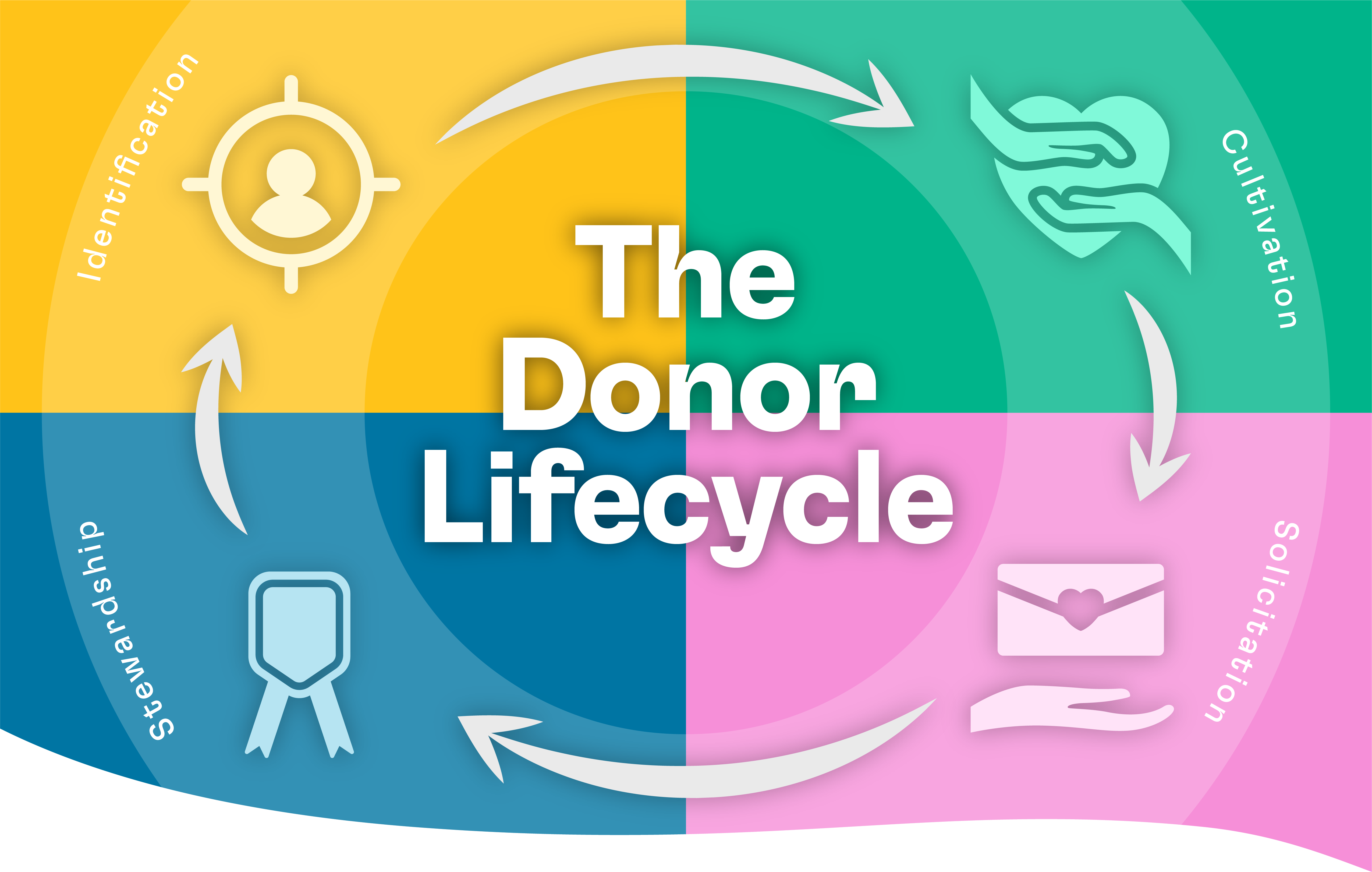
Top CRMs for nonprofits have the potential to become a lifecycle engine when the system features map directly to how donors are identified, cultivated, solicited, and stewarded over the course of their relationship with your mission.
Features that help you identify a prospect through analysis of giving trends and engagement behaviors are not the same tools needed to cultivate a stronger connection or personalize acknowledgments. When your CRM is not designed to help improve the outcomes through all of those stages, the donor relationships suffer and ultimately, less is raised. The best CRM for a nonprofit is defined by how well its features serve each stage of the donor lifecycle.
The Donor Lifecycle: A Framework for Evaluating CRM Features
The phases of donor relationship development, or donor lifecycle, include:
This cycle repeats until such time they are sufficiently invested in your organization's success, and you earn the chance to cultivate and solicit them all over again.
Each organization undertakes distinct steps to move donors through the lifecycle based on how prospects understand and interact with their organization, and what levers they have to pull to invite those donors to connect with their mission and its impact. Some acquire significant numbers of donor leads through events, or prospects are invited by current donors. Others get connected to a majority of their donor prospects through the constituents they serve. Program participants might request support in lieu of gifts around birthdays or significant milestones. Family members might witness the impact the programming is having and choose to give out of gratitude or inspiration.
Effective donor lifecycle tracking asks key questions:
Answers to these questions help nonprofit leaders assess what is working well and where the development team needs tools to support.
Looking at the feature lists of different donor management software won't tell you which system is best equipped to help your organization find, develop, appeal to, and care for donors. If you're a small organization looking for low-upfront-cost donor software, focus on features that support your weakest lifecycle stages. Not every nonprofit needs proprietary AI scoring, but every organization can benefit from having all of its data in one place and automated stewardship workflows. The best CRM for your nonprofit is the one whose features support each stage as your donors actually move through their relationship with your organization.
Identification Stage: CRM Features That Build Your Pipeline
This stage focuses on finding and capturing new prospects. It includes event attendees, website visitors, peer-to-peer participants, and referrals. Effective CRM features at this stage enable nonprofits to gather, organize, and analyze data from diverse sources to build a robust pipeline of potential donors.
At this pipeline entry point, prospects enter your database based on their initial interaction with your organization — often as an event attendee, website visitor, volunteer signup, email subscriber, social media follower, or referral from a current donor.
Many donor management systems include features to tag your donors. More and more are incorporating AI tools that auto-tag based on criteria like giving level or event attendance. The best systems allow you to customize the tags and curate your portfolios based on engagement behaviors and readiness indicators.
CRM features in action:
Cultivation Stage: CRM Features That Deepen Relationships
Once prospects are identified, the effort shifts to building meaningful relationships. Cultivation involves targeted communication, engagement tracking, and personalized outreach to deepen the connection and earn the opportunity to solicit donations. CRM tools that support dynamic segmentation and behavior-triggered outreach excel here.
During this relationship-building phase, prospects are engaged via mission stories, volunteer opportunities, event invitations, and impact reports — building understanding and affinity before being asked to invest in the outcomes.
Cultivation is the stage at which many nonprofits lose momentum. Fundraisers managing large portfolios of donors can lose sight of where each donor is in the cultivation sequence, creating a bottleneck that hinders relationship development.
CRM features in action:
Solicitation Stage: CRM Features That Drive Giving
Solicitation is the most important stage and yet the one most often mishandled. When you invite the prospect to make their first financial contribution — via email appeal, direct mail, major gift meeting, peer-to-peer campaign, or event sponsorship ask — the ask must be timely, personalized, and data-informed. CRM solicitation features help fundraising teams make the right ask, at the right time, through the right channel, and for the right amount. Integration of AI scoring, portfolio management, and automated workflows enhances effectiveness at this stage.
CRM features in action:
Stewardship Stage: CRM Features That Protect Lifetime Value
Post-donation stewardship is critical for donor retention and lifetime value. Penelope Burk's research found that 95% of donors said a "thank you" within 48 hours was the single most important factor in their decision to give again (Donor-Centered Fundraising).
By the time you've secured a gift from a new donor, your system has already gathered a significant amount of data that can help you steward them toward a deeper relationship and their next gift. CRM capabilities that automate personalized acknowledgments, track cumulative giving, detect lapsed donors, and coordinate household-level recognition ensure donors feel valued and engaged long-term.
Automating this thank-you ensures the stewardship starts off on the right foot and leaves the door open for future asks.
CRM features in action:
The All-in-One Advantage: Why Unified Platforms Win Across the Lifecycle
Understanding the donor lifecycle exposes more than general integration complications. It uncovers specific disconnects that occur when nonprofit systems are disconnected. These data losses between identification, cultivation, solicitation, and stewardship are the real "integration tax" nonprofits end up paying — and it's a cost to donor relationships, not just IT budgets.
- Identification → Cultivation Gap
Too often, the ticketing software perfectly captures the information of a new event attendee, but it never makes its way into the CRM's communication workflows. If you don't integrate systems, this supporter won't get any post-event cultivation or targeted engagement, and the relationship will slowly die before it has a chance to grow.
- Cultivation → Solicitation Gap
A donor's engagement score might be captured in a marketing automation tool, while the relationship manager's solicitation pipeline lives separately in the CRM. The fundraiser never realizes that this donor has opened every email for the past 6 months and is primed for a higher-level ask. Important indicators for timing and personalization are lost, making solicitation more of a guess and less effective.
- Solicitation → Stewardship Gap
When a major gift is made through an external payment system, the post-gift stewardship journey might not get triggered. Thank-you messages arrive late or feel generic, and the donor's next interaction misses the mark on recognition and genuine gratitude — putting the long-term relationship at risk.
Platforms like BetterUnite have a unified lifecycle model, with each feature built natively from the ground up. This eliminates these risks and gaps, without sacrificing features, because each capability shares the same donor record. This data continuity empowers nonprofits to move donors seamlessly through each lifecycle stage with personalized, timely interactions that deepen engagement and maximize revenue.
When you recognize the cost of cumulative lifecycle-specific data loss as an "integration tax" rather than a general IT expense, it becomes clear why the best CRM for nonprofits isn't just about features — but about how those features work together to encourage donor relationships at every step.
For a full comparison of CRM platforms and fundraising software, see our vendor analyses:
Related Resources from BetterUnite
- The Best Fundraising Software for Nonprofits: Features, Costs & Reviews
Compare BetterUnite, GoFundMe Pro, Bloomerang, Bonterra, and DonorPerfect on features, costs, and honest reviews for 2026.
- How Nonprofits Use Donor Management Software to Retain More Supporters
Unlocking donor loyalty: strategies, tactics, and technology for improving nonprofit donor retention.
- Why Your "Tech Stack" Matters for Nonprofits
Discover why disconnected tools create stress for nonprofits and how an integrated tech stack streamlines ticketing, donations, auctions, and more.
- What Nonprofits Deserve from Their Technology Partners
The nonprofit tech landscape is shifting fast. Here's how to stay vigilant, protect donor relationships, and choose software you can trust.
- How to Write Meaningful Thank-You Letters That Will Strengthen Donor Relationships
Learn how to write impactful, IRS-compliant thank-you letters that boost donor retention and show genuine appreciation.
- Fundraising Trends: Insights from 2024 & Strategies from BetterUnite
How nonprofits can thrive by transforming fundraising events and leveraging data for strategic, impact-driven experiences.
- Volunteer Management Programs That Work
Build a thriving volunteer program with strategies for recruitment, tracking, communication, and appreciation.
Want to see Donor Journeys in action for your organization?
Book a 20-minute walkthrough — bring your situation, walk away with a clear picture of whether it fits, whether or not we ever work together.
Stephanie Paz Townsend - NPO Consultant
Founder & Strategic Consultant | Paz Principles Consulting
Stephanie Paz Townsend is a strategic leader dedicated to accelerating social impact by blending relationship-driven engagement with data-driven decisions. A nonprofit strategy consultant with 2 decades of experience in development, marketing, and brand strategy, she combines behavioral analytics and personalized communication to deliver tactical insights that translate into sustainable growth.
As the founder of Paz Principles Consulting, she empowers mission-based organizations to deliver results through dynamic engagement plans, optimized data systems, and ethical storytelling. Known for her analytical approach and people-centered solutions, she specializes in cultivating strategic relationships and driving cross-sector partnerships with innovative, integrated marketing and fundraising strategies. Through each collaboration, Stephanie invites partners to turn shared intent into meaningful results, moving purpose into practice with compassion and decisive action.