The most valuable donor your organization will ever have is likely already in your database. Research shows that donors who stick around for five years give 1,519% more than first-year donors (Neon One, 2025). Still, most nonprofits lose over 80% of new donors each year (Fundraising Effectiveness Project, 2024). That's not a fundraising issue, it's an infrastructure challenge.
This is compounded by the fact that, on average, it costs about $1.50 per dollar raised to acquire a new donor, but only $0.20 to retain an existing one (ASU Lodestar Center for Philanthropy and Nonprofit Innovation, 2023). Donor management software, like nonprofit CRMs and fundraising software, can provide the infrastructure to support retention strategies and track results.
Assumptions:
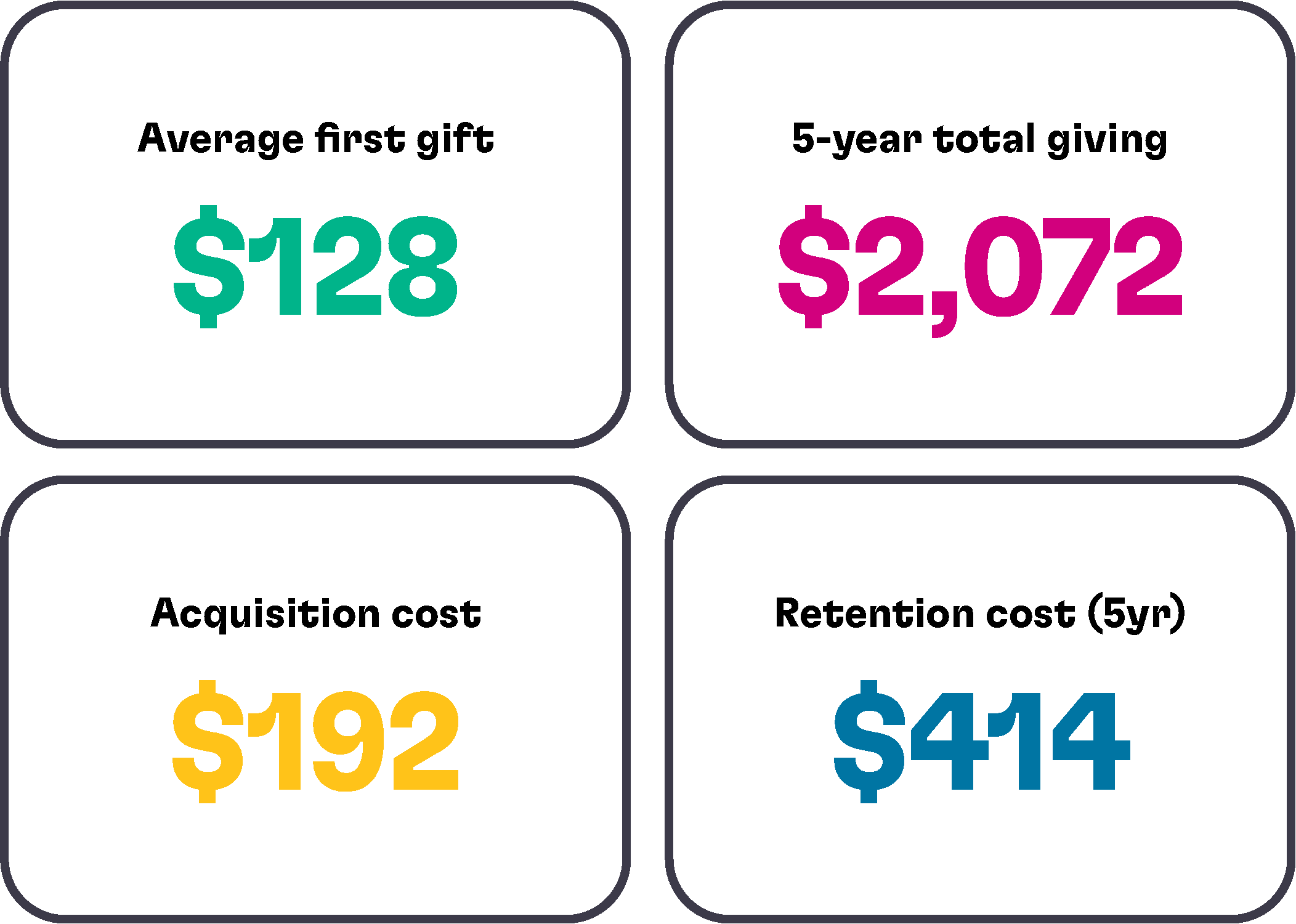
- Average one-time online gift: $128
- 5-year donor gives 1,519% more = 16.19x a one-time donor's total giving
- Acquisition cost: $1.50 per dollar raised → cost to acquire a $128 donor = $192
- Retention cost: $0.20 per dollar raised → cost to retain that same donor over 5 years = $0.20 × total giving
5-year retained donor total giving: $128 × 16.19 = ~$2,072
Net value (retained): $2,072 − ($1,959 × $0.20) = ~$1,658
Net value (one-time acquired): $128 − $192 = −$64 (a net loss)
The Compound Value of Donor Retention
What a single $128 gift is really worth over five years
Net value over 5 years
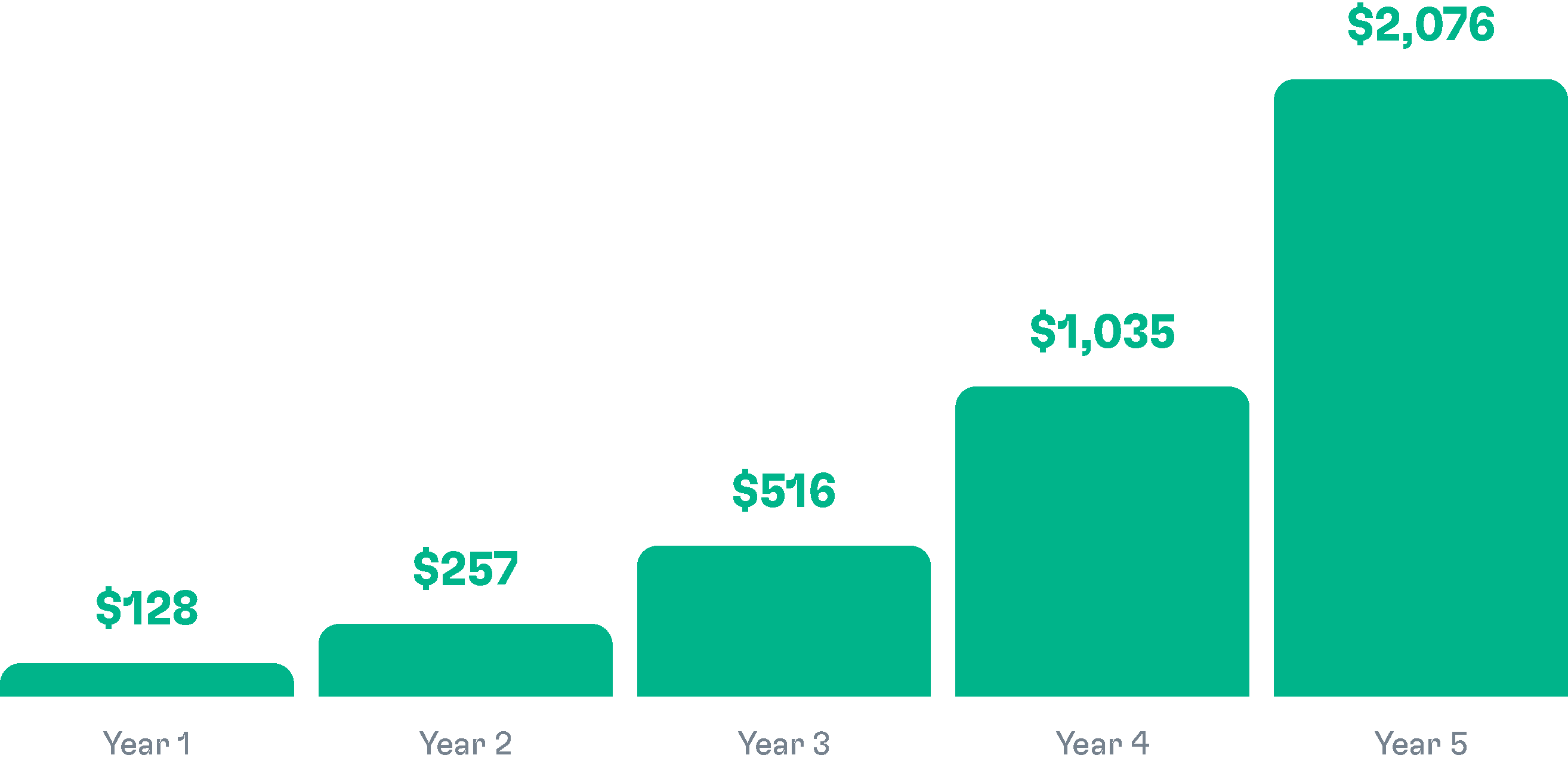
Year-by-year giving trajectory (estimated)
The cost gap
Sources: Five-year donor giving multiplier: Neon One 2025 Generosity Report. Average online gift ($128): M+R Benchmarks 2025. Acquisition and retention cost per dollar raised ($1.50 / $0.20): Fundraising Effectiveness Project / AFP. Year-by-year trajectory is modeled from the cumulative 1,519% figure using a compound annual growth rate and is illustrative.AI assistance: Compound value modeling and visual framework developed with assistance by Claude AI (Anthropic, 2026).
Unfortunately, many development directors are measuring the wrong thing. They're tracking dollars raised, donors acquired, campaign conversion rates, all the inputs. What they're not measuring is what happens to a donors in their second or third year, let alone year five and beyond.
Despite its importance, donor retention planning is often neglected. How an organization respondes in the days and weeks immediately following a donor's first gift can determine whether a donor becomes a one-time donor or a lifelong supporter. Common mistakes include assuming a receipt or tax acknowledgment serves is enough of a thank you or not having a move management plan to keep the donor engaged.
This guide explains how nonprofits use donor management software to retain more supporters and how the right platform turns one-time gifts into lifelong partnerships.
What Is Donor Management Software?
In the simplest terms, donor management software is a class of specialized constituent relationship management systems designed to track nonprofit-specific contributions such as monetary donations, volunteer hours, and in-kind gifts. These relational databases house and analyze donor records, giving history, communication logs, engagement tracking, segmentation, and automated stewardship workflows.
Through integrations, data from gift processing platforms, marketing tools and event management systems flow into the donor management software. A series of interrelated tables compiles the data into a unified view of donor profiles, replacing scattered spreadsheets and siloed systems. This allows nonprofit fundraisers to manage donor relationships, track their actions, and monitor resulting gifts.
Donor management software serves as the backbone of the fundraising ecosystem that includes event ticketing, email marketing, peer-to-peer fundraising, recurring giving, reporting and analytics.
Why Donor Retention Is the Metric That Matters Most
Donor retention is a fundraising KPI that measures how many donors give a second gift to an organization, within 12 months of their first gift. Focusing on retention can save an organization significant time and acquisition costs. Surprisingly, nonprofits often lose money on first-time donations, depending on the acquisition channel and relevant infrastructure. The only path to ROI is fundraising infrastructure that routinely converts first-time donors into second- and third-time donors.
Common challenges for retention are timely follow-up after a donation, continued donor engagement, and effective solicitation. On average, fewer than 20% of new donors are retained, making this a prime opportunity for nonprofit fundraisers. Through their initial gift, donors demonstrate some affinity for the organization and a connection to its mission, giving gift officers key information to begin a relationship and to earn the right to solicit the next gift.
One study found that increasing retention rates by 5% can increase revenue by 25-95% (Bain & Company), making this an essential metric to drive transformational revenue. Sadly, 76% of donors who stop or reduce giving report never getting follow-up (Bloomerang, 2024). This is where nonprofit database management can support fundraising efforts by automating acknowledgements, impact updates and renewal reminders. By using data in your donor management system to proactively identify and engage at-risk donors, your organization can reduce attrition and consistently engage supporters.
How Donor Management Software Drives Retention
In today's fast-paced nonprofit landscape, managing donor relationships effectively is critical to improving retention rates. Donor management software provides organizations with a shared system of record, centralizing donor information and automating essential stewardship tasks. Through helping organizations align tools around their priorities and coordinate activities to consistently engage donors, they are able to reliably translate relationships into revenue.
360-Degree Donor Profiles & Relationship Tracking
For years, development teams relied on a mix of spreadsheets, shared drives, outdated reports, and manual follow-up processes. Donor management software allows organizations to view a donor's complete giving history, communication logs, event attendance, and engagement scoring in one place. Each can be used to trigger workflows or personalize outreach, connecting what the donor has shared with how they are cultivated. Donor records can be segmented based on tags or custom fields to funnel them into donor journeys, such as a first-time donor welcome sequence designed to increase their understanding of the organization's mission impact.
Automated Stewardship & Thank-You Workflows
While there is a push to adopt more AI and embrace automation, the key is to balance task automation with authentic relationships to grow the donor base and preserve staff capacity. Fundraising strategy can be supported by donor management software that provides early-warning signals and personalized engagement tools. Best practices include automating donor receipt generation to replace manual thank-you processes and optimize delivery in the critical 48-hour window.
Donor journeys can be branched based on the donor lifecycle to enhance generic outreach with unique pathways, so that a $50 first-time donor is not receiving the same message as a $5,000 multi-year supporter. Lapsed donor re-engagement that often happens reactively (or not at all) can be jump-started with pledge reminders and recurring gift recovery workflows. Behavior-triggered task assignments for development staff can help to make personal touches at the right moment, when a donor is primed to give again.
Donor Segmentation & Personalized Communication
Effective donor retention depends on timing, execution and relevance of the outreach. Segmenting donors by giving level, recency, frequency, event attendance, and communication preferences can enable highly personalized marketing campaigns that reference individual giving histories, recognize donor milestones, and make targeted upgrade asks for mid-level donors ready to increase support.
Critical donor signals (connections, capacity, interests) are often buried in email threads or siloed systems that are labor-intensive to access, leading to delayed engagement. Promising donors can stall due to missed follow-ups, redundant outreach, or a lack of clarity on donor strategy. Donor journeys can automate consistent identification, so high-value prospects aren't overlooked. Engagement scoring further helps identify donors at risk of lapsing, supporting rapid interventions to prevent attrition.
Retention Reporting & KPI Dashboards
Data-driven decisions are one of the biggest opportunities nonprofit organizations overlook, likely because manual reporting is one of development teams' biggest pain points. Often masquerading as a necessary evil, in reality, it is a hidden drain on nonprofit fundraising efficiency. Real-time dashboards make it easy to track key metrics like donor retention rate, lapsed donor count, average gift size, and lifetime value, providing actionable insights without the need for spreadsheet manipulation or complex calculations. Portfolio analysis can show trends in first-time versus repeart donors and campaign ROI reports can focus fundraiser efforts. Automated, easy-to-use reporting tools can boost staff capacity and morale, especially when software features connect directly to mission impact.
Event-to-Donor Pipeline
Without systems to spot opportunities and guide action, converting event attendees and sponsors can become inconsistent and unpredictable. Applying moves management early in the donor journey, especially when someone sponsors an event or buys an auction item, shows that your organization is intentional and values relationships. If you wait until after a donor gives personally, you may miss your best chance to build a lasting connection. Engaging early helps set the tone and increases the chances of long-term support. Automating post-event follow-up through donor journeys and workflows keep the mission of the organization top od mind and deepen the relationship without missin a beat.
Strategies vs. Tactics: Building the Framework for Retention
Strategies for donor retention include renewing the original gift, upgrade the ammount, encouraging multiple gifts, or setting up recurring donations. Tactics involve how you ask, aka solicitation method, (bulk, personal, automated), what incentive your organization offers (key milestone, compelling story, gift match), and when you ask (durring events, campaigns, or holidays). Think of strategies as the plan's buckets and tactics as the tools to fill them. Donor engagement, such as opening emails or clicking links, can be an indicator of which donors are likely to give again. CRMs with AI can track these behaviors, spot patterns, and automate follow-ups to keep donors moving forward. Recurring giving pages also make it easier for donors to support your cause while making it one less thing to remember.
Donor Retention Best Practices
- Acknowledge every gift within 48 hours by using automation to distribute donation receipts and personalized thank you messages
- Segment donors (via automated tagging logic) by lifecycle stage instead of giving level: first-time, renewal, upgrade, lapsed, reactivated
- Use moves management plans and donor journeys with distinct stewardship tracks with dynamic content for $50 donors vs. $5,000 donors
- Identify at-risk donors before they lapse using engagement scoring (behavior tracking AI tools imbedded within the CRM)
- Run targeted re-engagement campaigns for lapsed donors with specific messaging about impact since their last gift
- Track retention KPIs monthly: average gift trend, first-time donor retention, upgrade rate, overall retention rate
- Show donors the impact of with impact reports their specific gift
How to Choose Donor Management Software
Improving donor retention is not just about adopting isolated tactics or chasing numbers—it requires a thoughtful, strategic approach that combines donor insights, individualized engagement, and streamlined processes. As we've discussed, donor retention depends on having a thorough understanding of your supporters, timely and meaningful communications, and leveraging technology that enables your team to nurture those relationships efficiently.
Donor management software provides the infastructure for this effort, unifiying disparate data and transforming manual workflows into a cohesive system that drives smarter, more personalized donor stewardship. The key is to select the right platform that will actually improve your retention efforts instead of adding complexity.
Start by cleary defining your retention goals. Do you want to lower donor churn, increase repeat giving, or convert more one-time gifts into recurring donations? Knowing which metrics you are prioritizing helps to focus your criteria on tools that deliver measurable impact.
As you evaluate platforms consider ways their features align with your current donor engagement and acknowledgement activities, concentrate on those that unify data and automate current manual processes. The most effective donor management software is the one your team adopts fully and uses consistently, freeing up their time to focus on building lasting donor relationships.
Framework:
- Define your retention goals: what metrics need the most attention?
- Audit your current donor data: how many systems are currently hold key information?
- Map your donor journey and identify where the pain points occur.
- Analyze the total cost of ownership (subscription + fees + staff time + integrations).
- Prioritize unified data and automation over feature count.
- Consider UI & support options because the best tool is one your team actually uses
Stephanie Paz Townsend - NPO Consultant
Founder & Strategic Consultant | Paz Principles Consulting
Stephanie Paz Townsend is a strategic leader dedicated to accelerating social impact by blending relationship-driven engagement with data-driven decisions. A nonprofit strategy consultant with 2 decades of experience in development, marketing, and brand strategy, she combines behavioral analytics and personalized communication to deliver tactical insights that translate into sustainable growth.
As the founder of Paz Principles Consulting, she empowers mission-based organizations to deliver results through dynamic engagement plans, optimized data systems, and ethical storytelling. Known for her analytical approach and people-centered solutions, she specializes in cultivating strategic relationships and driving cross-sector partnerships with innovative, integrated marketing and fundraising strategies. Through each collaboration, Stephanie invites partners to turn shared intent into meaningful results, moving purpose into practice with compassion and decisive action.